2024 Sound Bag & Cart Tour
· Audio · Accessories · 13:58
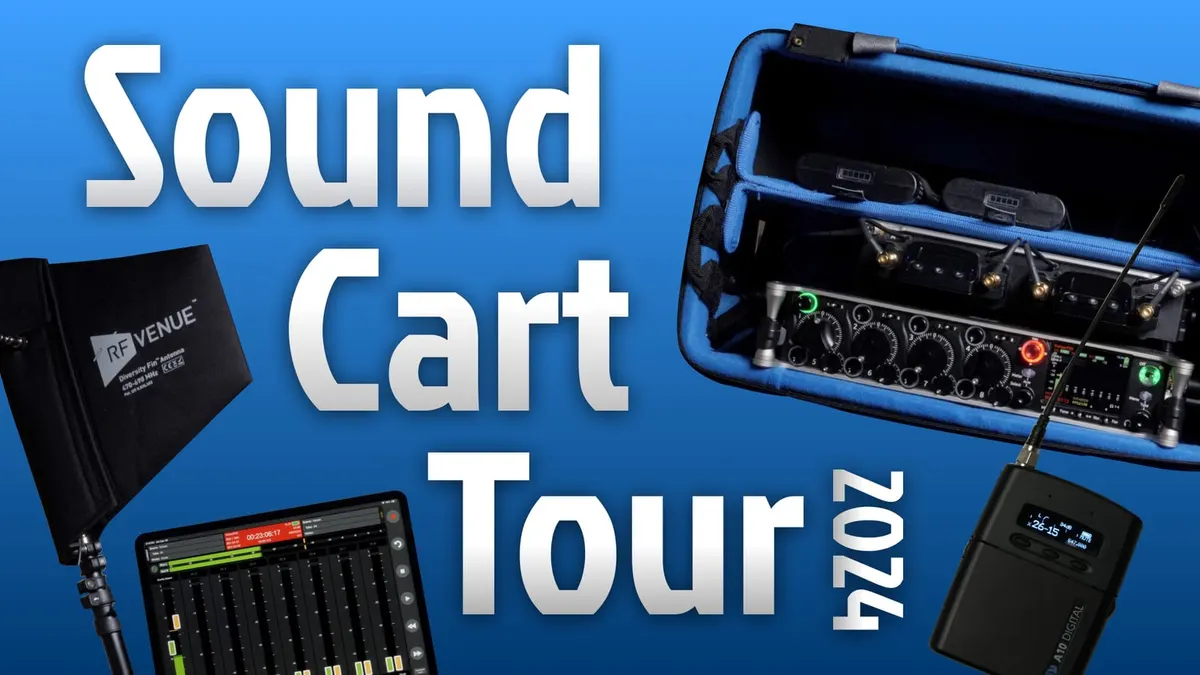
In this episode we give you a behind-the-scenes look at our sound bag and cart setup for recording on location!
Gear used or mentioned
The links below are Amazon, B&H Photo, Sweetwater, or other affiliate links. As an affiliate, I earn from qualifying purchases.
- Sound Cart Mini Cart
- Orca OR-34 Sound Bag — B&H
- Sound Devices 888 Field Recorder/Mixer — B&H, Sweetwater
- Sound Devices SL-2 Slot Receiver System — B&H
- Sound Devices A20 Wireless Mic System — B&H
- Sound Devices A20 Mini Wireless Mic Transmitter — B&H
- Deity Theos Wireless Microphone System — B&H
- HiQ/Inspired Energy Smart Batteries — B&H
- PSC Triple Play Power Distribution System
- Sennheiser MKH 8050 Supercardioid Condenser Mic — B&H, Amazon
- Sound Devices MixPre Series II Recoders — B&H, Sweetwater, Amazon
- Impact Turtle-Base C-Stands — B&H, Amazon
- Aputure LS 600x Pro Bicolor LED Light — Aputure, B&H, Amazon
- Aputure Light Dome III Softbox — Aputure, B&H
- Amaran 300c RGBWW Single-Point LED Light
- Amaran Spotlight SE — Aputure, B&H, Amazon
- Rosco Prismatic Glass Gobo in Cool Lavender — B&H
- Canon C70 Cinema Camera — B&H
- Canon RF 24-70 f/2.8 lens — B&H, Amazon
- Panasonic GH5 camera — B&H, Amazon
- Panasonic 12-35mm f/2.8 II lens — B&H, Amazon
Read the transcript
A tour of the reviewer’s professional sound cart as of early 2024, built around a Sound Devices 888 (upgraded from a 633 in 2019) — acknowledged as somewhat overkill for his current freelance workload (mostly small-to-medium budget commercial/lifestyle/short-film location work, typically maxing out around 6 channels); if buying today, he’d likely choose the smaller 833 instead.
An SL-2 slot system attached to the 888 handles up to 8 wireless channels digitally (no analog conversion); in this setup, two dual-channel Sound Devices A20 receivers provide 4 wireless channels without using any of the mixer’s analog inputs. The system uses true diversity reception via an RF Venue diversity fin antenna, which combines a vertically-oriented log-periodic dipole array (covering roughly 470-698MHz, most of the US-usable UHF range) with a second, horizontally-oriented dipole, so the system can favor whichever antenna best matches a transmitter’s orientation on a moving subject.
Control is handled via an iPad Pro with a keyboard running Sound Devices’ app, enabling quick metadata entry per take, multi-touch simultaneous fader/trim adjustment (an advantage over mouse-based single-point control on a computer), full channel views (1-16, individually or combined), bus routing views, output fader control, and sound-report generation.
Power comes from a PSC Triple Play distribution system fed by a custom-cabled 1kWh lighting battery (good for about 6+ hours even running all wireless channels) plus two 98Wh smart batteries as hot-swappable backups, so any single battery can be swapped without losing power to the system.
Cart features: a retractable iPad shelf, a side-mounted script holder arm, a headphone hook, and a rear boom-pole holder. On the A20 wireless system (upgraded via a Sound Devices retrofit program from original A10 receivers), gain is set at the receiver rather than the transmitter — transmitting a low, headroom-rich signal and applying gain at the cart, so levels can be adjusted quickly without needing to access the talent’s body pack. The remaining four transmitters are still older A10 units, not yet worth upgrading given current workload. For sending a monitor feed to a director or producer (a lightweight IFB setup), a Deity Theos transmitter/receiver pair has recently been added to the kit.
The cart itself is a modular Sound Cart Mini (a British design) with adjustable shelves and an optional rack-mount unit; the bag can be detached via two bungee cords and worn on an Orca OR-35 harness when needed, though the 888 setup is heavy enough that the reviewer prefers working from the cart whenever possible. It has large rear inflatable wheels, locking front casters, and a foldable handle allowing it to lie flat for transport in a vehicle.
Viewers can join weekly Sunday livestreams on the Curtis Judd Audio channel (topics posted Saturdays) or sign up at school.learnlightandsound.com for topic emails and to submit questions ahead of time. Get out there and make some great sound.