
Aputure Storm 400x — This light is actually better than most LEDs
· Lighting · 8:04
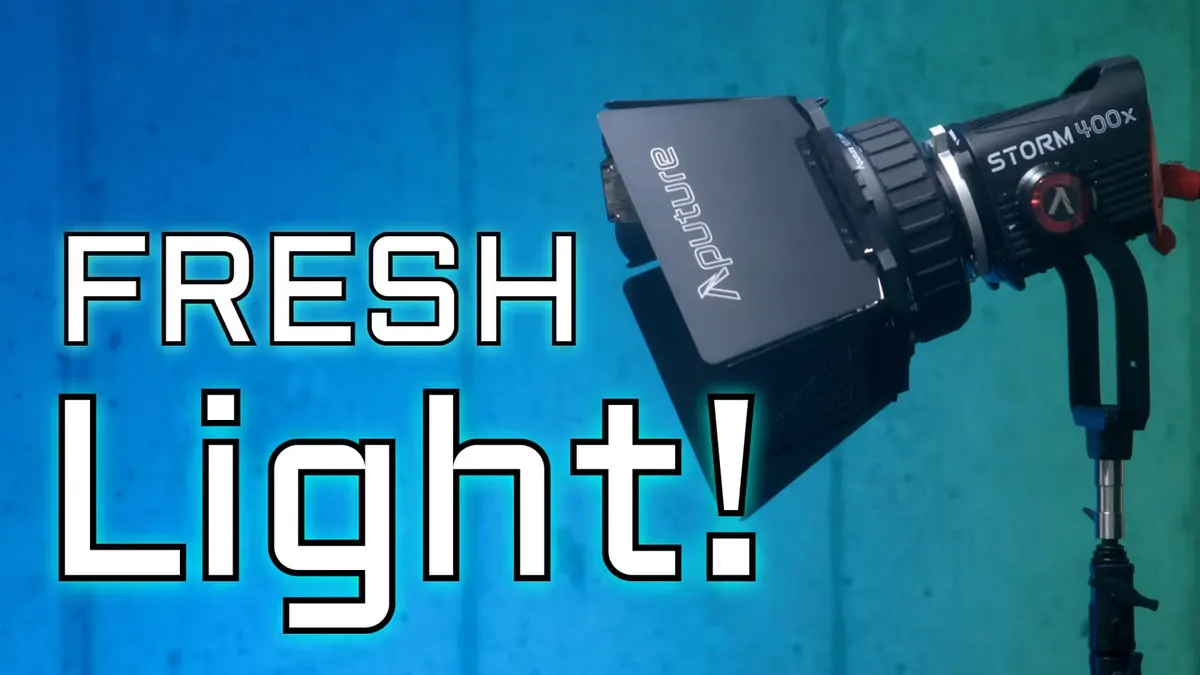
In this week’s episode, we have a look at the new Aputure Storm 400x LED light. This LED makes use of the BLAIR lighting engine, which includes some different emitters in its chip than most other LEDs on the market. What difference do these colors make? Let’s take a closer look and find out!
Gear used or mentioned
The links below are Amazon, B&H Photo, Sweetwater, or other affiliate links. As an affiliate, I earn from qualifying purchases.
- Aputure Storm 400x — LED Light
- Aputure LS 600x — Pro Bicolor LED Light
Read the transcript
Full disclosure, Aperture sent me the Storm 400X light and the compact Fresnel with barn doors; they haven’t told me what to say or reviewed this before posting. I haven’t done many lighting reviews lately since lights haven’t had much breakthrough technology — but this one is different, because it uses Aperture’s Blaire lighting engine: blue, lime, amber, indigo, and red LEDs, with no white LED emitters at all, unlike typical bicolor/RGB/daylight lights.
The key difference is fluorescence — a quality that black-body emitters like tungsten bulbs and actual daylight naturally have because of indigo content in their spectrum, which makes whites (clothing, teeth, eyes) look vibrant rather than dull. Most LED lights, including earlier Aperture Lightstorm panels I’ve used since around 2015, have lacked that indigo content and always looked a bit “dull” on whites compared to old-school tungsten, despite tungsten’s major downsides: massive heat output, huge power draw, and tripped breakers on both home and office circuits.
A side-by-side comparison of a white sound blanket lit by the Storm 400X versus the previous-generation 600X (also bicolor but using tungsten/daylight white chips) shows a dramatic difference — CRI scores are similar, but the SSI (Spectral Similarity Index) at daylight settings jumps from a typical ~73 for quality LED lights to 87 thanks to the Blaire engine’s indigo emitter.
Other notable features: a locking Bowens mount (like a PL mount for cinema lenses) that holds modifiers more securely, though it’s incompatible with some older non-locking modifiers like Aperture’s Fresnel F10; dimming down to 0.1% with no flicker even at an 11.25° shutter angle, enabling much more refined lighting designs than lights that can’t dim low enough to be useful as subtle fill/accent light; IP65 weatherproofing; full plus/minus green tunability (equivalent to green or magenta gels) plus color temperatures from 2500K to 10,000K, together covering 87% of the Rec.709 color gamut despite being a tunable-white (not RGB) light; and support for Sidus Link, Sidus Pro, wired DMX, and CRMX control.
Photometrically, at 1 meter the 400X’s output is nearly in the same league as the earlier 600X Pro, and with the optional compact Fresnel (narrowing the beam from 40° to 15°) it measured f8.1 at 23.976fps/ISO800/180° shutter in full spot, f4.0 in full flood — impressive output from just 400 watts. Priced at $1,600 USD (Fresnel/barn doors TBD). This light is well suited for small studios and small production companies as a “big gun” complemented by smaller fill lights. Get out there and make some great lighting designs. We’ll talk to you again soon.