
Can You Use a Shotgun Mic Indoors? Shotgun vs Pencil Condenser Boom Microphones
· Audio · Microphones · 7:23
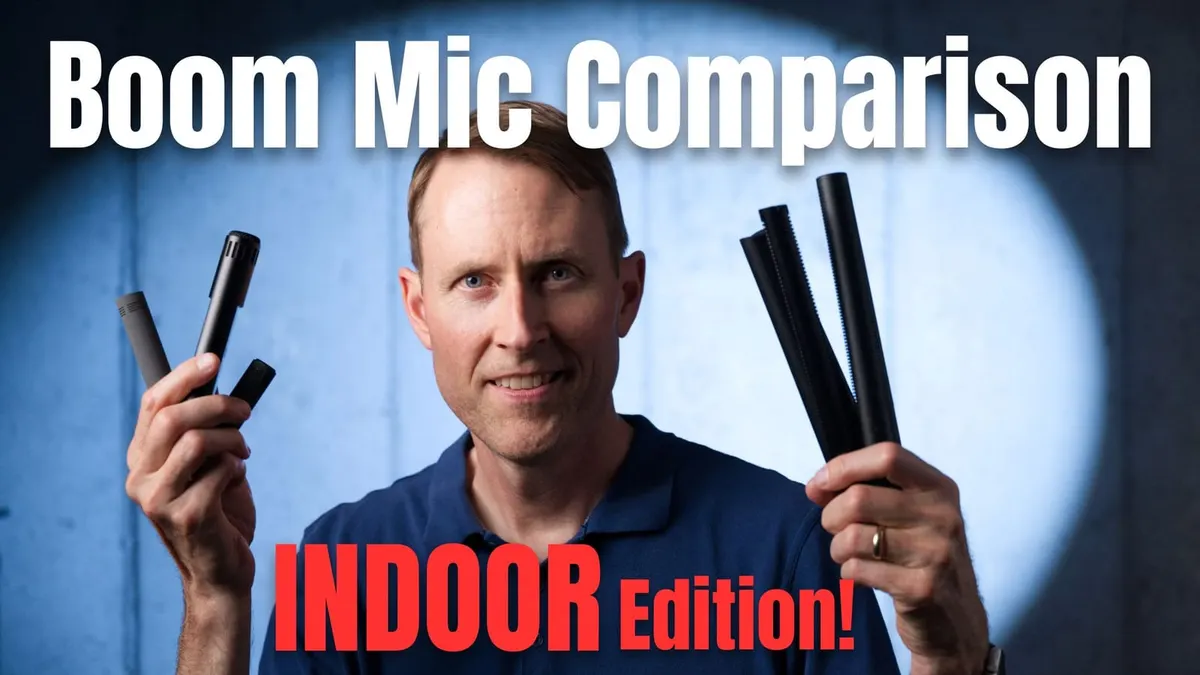
Can you use a shotgun microphone indoors?
In this episode, we critically listen to a variety of boom microphones in a reverberant, echo-y indoor space. We record with a variety of shotgun microphones versus non-shotgun (pencil condenser) boom microphones and answer the question: Can you use a shotgun microphone indoors?
Gear used or mentioned
The links below are Amazon, B&H Photo, Sweetwater, or other affiliate links. As an affiliate, I earn from qualifying purchases.
- Sennheiser MKH 416 Supercardioid Shotgun Condenser Microphone — Trew Audio, B&H, Sweetwater, Amazon
- RODE NTG5 Short Shotgun Microphone — B&H, Sweetwater, Amazon
- Deity S-Mic 2 Shotgun Condenser Microphone — Trew Audio, B&H, Amazon
- Azden SGM-250 Professional Shotgun Microphone — Amazon
- Sennheiser MKE 600 Shotgun Microphone — Trew Audio, B&H, Sweetwater, Amazon
- DPA Microphones 4017B Shotgun Microphone — B&H, Sweetwater, Amazon
- Audio-Technica AT4053B Hypercardioid Condenser Microphone — B&H, Amazon
- Sennheiser MKH 50 Supercardioid Condenser Studio Microphone — Trew Audio, B&H, Sweetwater, Amazon
- Sennheiser MKH 8050 Low-Profile Supercardioid Condenser Microphone — Trew Audio, B&H, Amazon
- Schoeps CMC641 Supercardioid Microphone Set — Trew Audio, B&H, Sweetwater
- SoundDevices MixPre II Series Audio Recorders — B&H, Sweetwater, Trew Audio, Amazon
- Impact Turtle-Base C-Stands — B&H, Amazon
- K-Tek 36”-12’ Graphite Boom Pole — B&H, Amazon
- Amaran 200x S LED light — B&H, Amazon, Aputure
- Aputure Light Dome II soft box — Aputure, B&H, Amazon
- Aputure Spotlight Mount — Aputure, B&H, DVE Store, Amazon
- Rosco Prismatic Glass Gobo in Cool Lavender — B&H
- Canon C70 Cinema Camera — B&H
- Canon RF 24-70 f/2.8 lens — B&H, Amazon
- Panasonic GH5 camera — B&H, Amazon
- Panasonic 12-35mm f/2.8 II lens — B&H, Amazon
Read the transcript
[Music] Don’t use shotgun microphones indoors!
This is probably advice that you have heard before.
And for many of us, the question is, well, why?
Why is that the advice? And the recommendation instead is to use small diaphragm condenser microphones that are often called pencil condenser microphones.
So… why? Here’s the reasoning. The interference tube on shotgun microphones, a longer tube with lots of slits on the sides, uses the laws of physics to help reduce sounds coming from the sides.
That is to say, it reduces how much of the sounds from the side are picked up by the microphone. Outdoors, where there typically aren’t as many flat hard surfaces to reflect the sound of your voice back into the side of the microphone, this whole interference tube design generally works pretty well. But indoors, where there are hard walls and ceilings and sometimes even hard floors or tables that reflect back sound into the side of the microphone, the overall sound starts to sound less like real life.
It’s colored and starts to sound unnatural.
So instead of using a shotgun microphone, you can use a supercardioid pencil condenser microphone when booming a mic from above when you’re working indoors.
These microphones don’t have interference tubes, so they aren’t always quite as directional, but they don’t suffer from the same coloration when recording indoors.
They don’t necessarily reject more of the reflected sound, but they tend to sound less colored and more true to life than a shotgun microphone.
So here are some examples recorded in a reverberant space.
We recorded a series of shotgun microphones- these are the longer microphones with the interference tubes- and then a series of pencil condenser microphones.
We do that first with Dani’s voice and then we do the exact same thing again with Emma’s voice so you get some variety in the different voices.
When you get to the Audio-Technica 4053B, that’s the first of the pencil condenser mics.
All of those before that are shotgun microphones.
So use your best headphones and have a listen and see if you can hear additional coloration on the shotgun microphones versus the pencil condensers. [Sample Audio] Now, of all of those, there was plenty of reverb in all of those, and especially if you’re wearing good headphones, you’ll definitely hear it.
The one microphone that sounded the best to me of all of those was the Sennheiser MKH50.
Now, one thing that I think comes up as a question as well, can I use pencil condenser microphones outdoors as well? Yes, you can. They’re not necessarily quite as directional and that’s, you know, depends on, differs from microphone to microphone, so it really depends on the microphone, but yes, you can use them outdoors. You will need wind protection for them when you’re working with them outdoors, but you can use them outdoors.
And the reason I’m going into this whole thing is a lot of times people that are getting into video are like, I can only afford one microphone, which microphone should I get, a shotgun microphone or a pencil condenser boom microphone for my boom?
And I would actually say amongst all of those, the one that sounded best to me in the indoor space here and the samples you just listened to was the Sennheiser MKH50.
If I could only choose one microphone, that’s the one I would choose.
I do most of my recording indoors, to be fair.
If you do most of your recording outdoors, probably a shotgun might be a better choice for you. But in any case, I didn’t feel like any of those were so colored that they could not be used indoors and absolutely should not be used indoors.
I think for professional production sound mixers who are earning their primary living recording sound for film and TV shows, yeah, they should definitely probably optimize their microphone and use a pencil condenser indoors and consider using whatever works best for the outdoor situation that they’re in.
But for those that can only afford one microphone, hopefully this is helpful for you to answer that question. Yeah, you can probably, if you can only afford a Sennheiser MKE600, I think that could be a pretty good choice for you, good microphone to fulfill those needs.
So I hope that was helpful for you.
If you have any questions, go ahead and leave them down below.
Get out there and make some great sound, and we’ll talk to you again soon. [Music]