
Make Any Mic Sound Better with the RODE DS3 Desktop Microphone Stand
· Audio · Accessories · 7:28
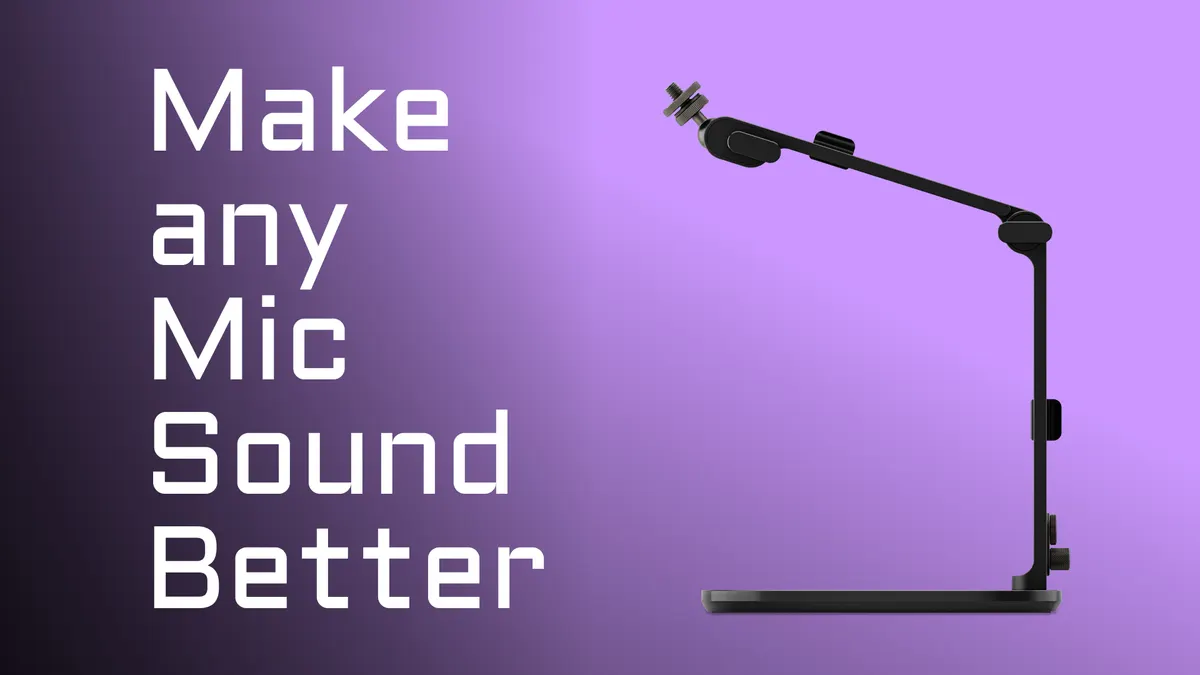
Any microphone you use will sound its best when it is positioned in the optimal position — close, but not too close. There are a ton of great microphone arms you can use, but sometimes you want something that isn’t attached to your desk or table, something you can more for different situations. But the problem with many desktop stands, is that they’re not able to hold larger microphones or microphones in larger shock mounts. That’s where the RODE DS3 desktop stand fills a need — this beefy desktop stand can hold almost any microphone.
Gear used or mentioned
The links below are Amazon, B&H Photo, Sweetwater, or other affiliate links. As an affiliate, I earn from qualifying purchases.
Read the transcript
Today we’re going full analog. One of the things you can do to improve the sound of your microphone, regardless of which microphone you’re using, is to put it in the right position. And here we’re going to talk about a desktop stand.
Let me give you some context here. When I was first getting started in audio, I didn’t have a lot of money to spend on my audio gear, so I had to kind of scrimp and scrape to afford what I could get. And one of the things I needed was a desktop stand. So this is the first one I bought. This is an On-Stage stand. I don’t know what the model was called. It was, I believe, $13. It is evidently made in China. It has kind of a weighted base. Straight stem here. You can extend it. It’s got a 5/8-inch thread at the top. Pretty simple.
And this is fine for certain kinds of microphones. But my first large diaphragm condenser microphone, which I bought to do podcasting and voiceover, was a RØDE NT1-A. And for those that are familiar with the RØDE NT1 series — for example, here today we’re using the NT1 5th Generation — it has a traditional shock mount that it comes with, and that shock mount connects at the back here to whatever stand you put it on. So when you put it on a stand like this, it extends out. And this stand becomes tipsy city when you put a shock mount like that on it. So that meant I had to put a sandbag on the base as well to weigh it down so that it wouldn’t tip over. Not the greatest look, especially if you’ve got it on camera. Not the best fit there. Also, didn’t travel well.
But that’s not necessarily what you’re looking for with a stand like this. The benefit of this, that I see, is that this is good for situations where you need to be able to place it on a desk or a table and move it. So if you’re doing a portable setup, podcasts that you’re doing on location or something, or you want it on your desk but you don’t want to attach a permanent arm to your desk, a mic arm to your desk, that’s where a desktop stand is really handy.
In 2023, RØDE released the DS2, which is this guy right here. Nice weighted base. Could handle a lot more weight than a stand like this without tipping over, and it could support the RØDE NT1 in its shock mount, but just barely, depending on the angle that you had this arm here. And you can adjust this angle, but most angles, it was just barely holding it. And if you put it down too low, like this, which you have to do sometimes to get it to the right height for the person that’s speaking into the microphone, then it would definitely tip over. So it would still work okay for certain types of mics, like maybe a Shure SM58 in a mic clip, rather than a shock mount — one that just sits right over the stand itself. But for these beautiful microphones that they are, it just wasn’t a great solution, even the DS2, unfortunately.
All right, enter the DS3. Bigger, beefier, heavier, and able to handle a RØDE NT1 without any problems whatsoever. That’s what we’re using right here right now. You can’t see it, it’s out of the frame. Maybe I can lift it up here so you can. That is the DS3 with the RØDE NT1 with its native shock mount, and it is holding it up with no problem whatsoever.
Now, as a test, we also have one of my favorite microphones — kind of niche, but the RØDE NTR is a large ribbon microphone that weighs in at a massive 1,047 grams. This stand also holds it without problems. So this stand can hold almost any microphone without having tipping problems.
It does have two adjustment points. First up, the ball joint to which you connect the microphone clip or shock mount — it can be adjusted in almost any position. And a hinge at the back, where you can adjust basically the angle of the arm to tune in the height and the reach of the stand. The mount is 3/8-inch natively, but there is, here on the back of the stand handily, a 5/8-inch adapter and a 1/4-inch adapter. So you can pretty much mount any microphone, whether it’s 5/8-inch, 3/8-inch, or even other accessories like maybe a small light using that 1/4-inch adapter as well. So some flexibility there.
On the base, there’s a pad. It comes with a silicone pad with a magnetic back, and you can just take that right out of the base here and replace it with a different pad if you’re interested in that. So they make a cork one as well. Softer material than the metal base presumably helps a little bit with sound reflections. Do I have a way to test that? I mean, I guess I could take this off and you tell me if you hear a difference. Okay, here’s the pad, magnetic back. Here it is with it off, and I’m talking, talking, talking, and then we’ll go ahead and put it back on. And now I’m talking, talking, talking with the pad back on. I don’t know if it’s going to make a huge difference, but every little bit helps.
So thank you, RØDE. The branding on this, the brand badge — RØDE has a history of doing subtle sometimes and doing in-your-face other times. So the RØDE PSA1, the microphone arm: love that arm. It’s actually incredibly sturdy, really well built, and it screams RØDE as if it’s a NASCAR or an F1 racer. This one, thankfully, they went much more subtle on the brand badge. It is a dark black on a lighter black metal stand, and you can barely see it, which I think — I think you need to give your customers the option to not have it screaming. And they did the right thing here with the DS3. So thank you, RØDE. I appreciate that so much.
Now, to achieve this stability, obviously it has to be really, really heavy. It’s pretty much all metal. The knobs, I think they might be metal too. They have that kind of cooler feeling. It’s 98 to 99% metal, this whole thing. So it weighs a lot. It comes in at 2.6 kilograms, or 5.73 pounds. This is not the type of thing you’re going to throw in your travel bag to go with you, most likely.
But on the flip side, that makes it so it can handle these enormous — it can handle, I’m going to say, pretty much any microphone. If you have a microphone that this stand can’t handle, then you probably spent a lot of money, or you’ve created a Frankenstein. I don’t know which one of those.
In any case, this stand is super solid. If you can appreciate a quality analog, finely manufactured metal stand that does its job without fuss, that will probably last longer than your time, this is worth your consideration. It runs $109 US. Is that worth it? I think it’s a fair price point. If you’re at a point in your life where you’d rather buy once and cry once, and then have a desk stand that will last you for the rest of your life, you should consider the DS3.
Hope that was helpful. Get out there and make some great sound. Talk to you again soon.