
My Favorite Shotgun Microphones Ranked
· Audio · Microphones · 23:55
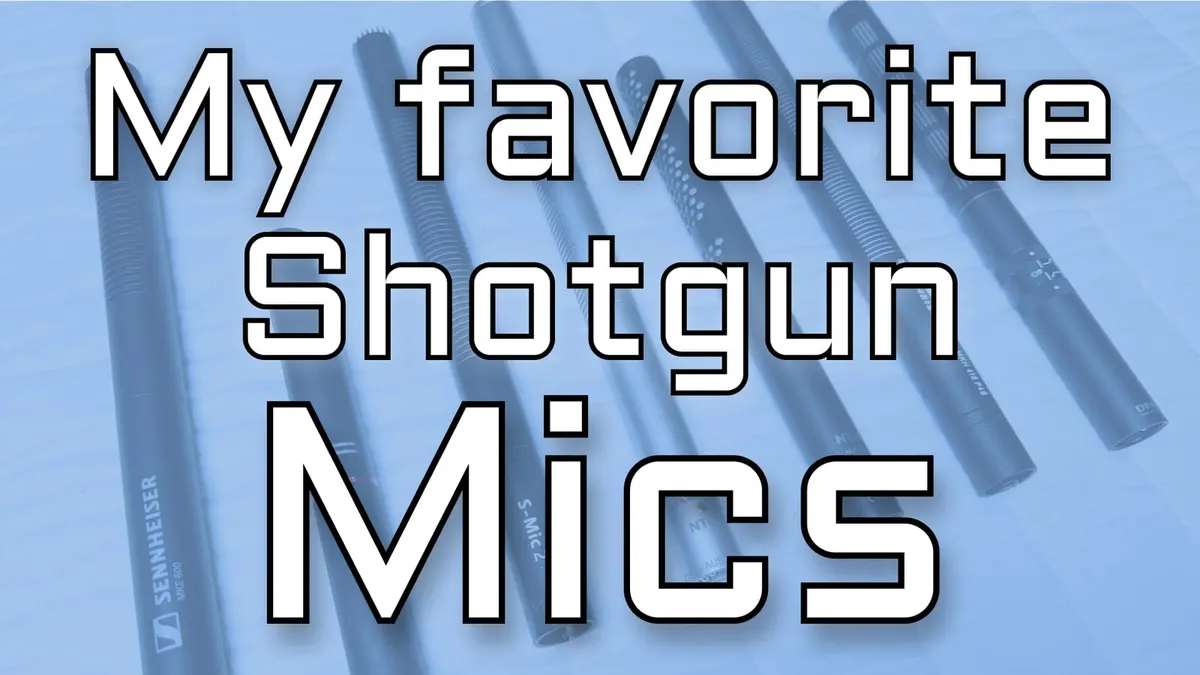
In this episode I rank my favorite shotgun microphones in different price categories - under $300, $300 - $500, $500 - $1000, and $1000+. This is based on my experience and is totally SUBJECTIVE. Let’s talk it through!
Here’s a table with all of the microphones ranked and my notes.
Gear used or mentioned
The links below are Amazon, B&H Photo, Sweetwater, or other affiliate links. As an affiliate, I earn from qualifying purchases.
Read the transcript
Personal, subjective rankings of XLR shotgun microphones I’ve used, grouped by price tier. All comparisons below $1,000 are recorded through a DPA 4017B for consistency (except where noted the mic being discussed is what you’re hearing).
Under $300: #4 Godox VDS-M3 (~$200, was $300) — noisy, thin sound, non-replaceable battery; has a high-pass and presence boost but not recommended overall. #3 Movo X3 II ($130) — rich, broadcasty sound when phantom powered, decent shock mount and high-pass filter, but sounds poor on AA/3.5mm camera adapter use; good budget pick if phantom powered. #2 Rode NTG2 ($269) — sounds good via XLR but needs a lot of gain (I regularly used 55+ dB); poor on 3.5mm/AA power; has a high-pass, no presence boost. #1 Audio-Technica AT875R ($169) — a bit bright but sounds quite good for the price, no filters, my top pick under $300.
$300-$500 (biggest category): #9 Rode NTG4+ — thin sounding, non-replaceable battery, has high-pass and presence boost. #8 Azden SGM-3500 ($499) — mid-rangey, overpriced for the performance. #7 Sony ECM-674 ($325) — mid/bright, needs EQ, has high-pass only. #6 Azden SGM-250H ($329) — better-voiced Azden, can get sibilant on sibilant voices, has high-pass only, fair price. #5 Deity S-Mic 2S ($319) — decent, moderate self-noise, wider polar pattern than the standard S-Mic 2 (newer S-Mic 3S exists, untested). #4 Rycote HC-15 ($449) — neutral, good self-noise, wider polar pattern as a short shotgun, no filters, solid all-around. #3 Sennheiser MKE600 ($329) — nice rich low end, crisp highs, a bit more brittle than the MKH416 but a great value “poor man’s 416,” works well on 3.5mm/AA power too, has high-pass only. #2 Deity S-Mic 2 ($359) — durable brass body, wider pattern than the MKH416, less colored, some water resistance, no filters. #1 Rode NTG5 ($499) — my top pick in this range; RF-bias design (resists humidity/condensation issues that plague DC-bias mics), wider pattern than the MKH416, neutral sound, includes a shock mount; early units reportedly had RF interference issues but I never experienced that and haven’t heard much about it recently.
$500-$1,000: #4 Azden SGM-3500L ($549) — a longer, more isolating/directional specialty mic for extra reach, not a first choice for most cases, no filters. #3 Rode NTG3 ($699) — rich, occasionally slightly woolly low end, holds bass well at distance, less bright than the MKH416, RF-bias, solid build, great value for the money. #2 DPA 2017 ($995) — a lower-cost, non-modular relative of the DPA 4017B with a good balanced sound, no filters, a buy-once-for-your-career kind of microphone. #1 Sennheiser MKH416 ($999) — the classic since the 1970s (now 48V phantom powered); colored but in a way most people love — bassy with crisp highs and a mid scoop; heavier, more directional than most, no filters; kept mainly as a reference mic given its popularity.
Over $1,000: DPA 4017B (bought years ago for $1,700, now $2,100) — my go-to for outdoor commercial/paid work: smaller and lighter than the MKH416, more neutral/faithful sound (not necessarily the most flattering, but very true to the source), has both a high-pass and presence boost (I use the presence boost when it’s inside a wind cover like a Rycote Cyclone or Nanoshield), and is modular — the capsule/interference tube can be unscrewed from the preamp module and swapped. Like most shotguns, off-axis sound is fairly colored, though the 4017B does comparatively well there for a shotgun; a small pencil condenser would still be cleaner off-axis if that matters most to you.
These rankings are purely subjective, based on my own experience — treat this as one data point, especially before spending real money on the pricier options; listen to more samples and opinions first. Get out there, make some great sound, and we’ll talk to you again next week.