
TASCAM DR-40XP 32-bit float audio recorder - Is it clean?
· Audio · Recorders · 8:58
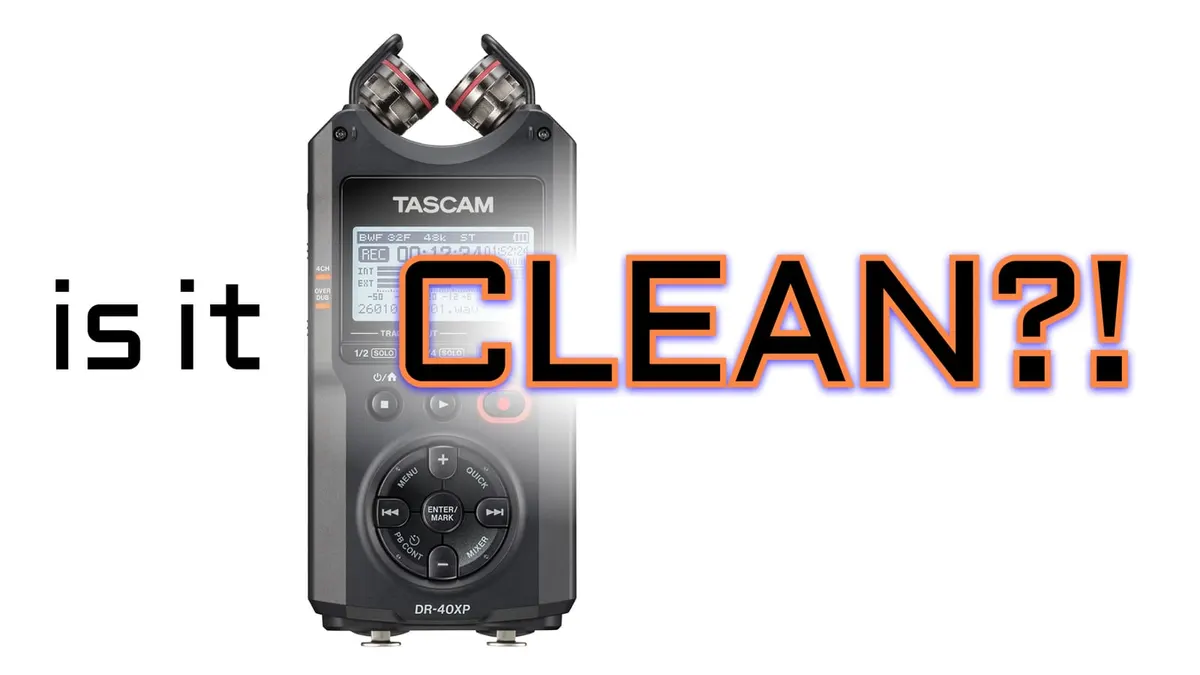
In this week’s episode we take a look at the new TASCAM DR-40XP 32-bit float audio handheld field recorder. And the big question most people are asking is, “Are the preamps on this new version cleaner than the last version?” And the answer is…YES!
Gear used or mentioned
The links below are Amazon, B&H Photo, Sweetwater, or other affiliate links. As an affiliate, I earn from qualifying purchases.
- TASCAM DR-40XP — 32-bit float Field Recorder
- SHURE SM7B — Cardioid Dynamic Studio Microphone
- JZ Mics V11 — (the ‘deodorant mic’- not an affiliate link)
Common questions
Are the DR-40XP's preamps cleaner than the DR-40X?
Yes, substantially. I measured -85 dB RMS max on low gain at an input level of 50, the setting I use with a Sennheiser MKH50. With a quality condenser this recorder is good enough for 99.9% of use cases.
Can I use a Shure SM7B with the Tascam DR-40XP?
Absolutely. With gain set to high and the input level at 50 out of 100, I measured -78 dB RMS max. Most people aren't going to hear that noise floor.
Read the transcript
The first question people want to know is: the Tascam DR-40XP. Does it have cleaner preamps than the predecessor- the previous version? First of all, thank you to Tascam for sending this recorder over to me so that I can make this review. They haven’t told me what to say. They haven’t paid me any money.
Is this cleaner than the previous generation the DR-40X? This is a recorder line that’s been in production for decades, and this is the XP version. The spec says that the self-noise is minus 126 dBu. I have this dummy XLR adapter with a 150 ohm resistor across pins two and three, which simulates the load of most dynamic microphones without adding signal or noise from the microphone itself, so it’s a great way to measure the self-noise produced just by the preamplifier and converters.
We measured the self-noise floor at -85 dB RMS max with the preamp on low gain, an input level of 50 — the gain setting I use with a condenser boom microphone, the Sennheiser MKH50. That means it’s pretty clean; you’re not going to hear a bunch of noise from the preamplifier. So it does appear to be substantially cleaner in the XP version. If you’re using a quality condenser microphone, this recorder is going to be good enough for 99.9% of use cases.
What about microphones like the Shure SM7B, a dynamic microphone that needs a ton of gain? With the gain set to high and the input level at 50 out of 100, we get an RMS max level of -78 dB — also great. Most humans aren’t going to be able to hear that noise floor. Can you use a Shure SM7B with the DR-40XP? Absolutely you can.
Here’s a really important thing I want you to know about the DR-40XP: with preamp performance like this, you really don’t need to be worried about the preamp anymore. You need to be worried about your microphone and the environments in which you record — the ambient noise. Microphones generally add more self noise to your overall recording at this point than recorders do.
Another thing you need to know: the DR-40XP only has one analog to digital converter, and it’s a 32-bit float recorder. This recorder has a dynamic range of 112 decibels on its XLR inputs and a max input level of +7 dBu. Compare that to the Zoom f8n Pro, which has a dynamic range of 113 dB — only one dB more — and a max input level of +4 dBu, three dB less than the Tascam. That means the DR-40XP can actually handle higher input levels than the Zoom f8n Pro. Does that make the DR-40XP better? Not really — specs are useful tools, but they don’t tell the whole story.
In practical use, it’s going to be fine for most people, and it looks to me like quality preamps and converters are getting to a point where even these budget recorders are good enough for most people recording spoken word audio for video. If you want a DR-40XP and it fits your use case — built-in microphones plus two XLR inputs — great, go for it. If you have more expensive tastes, maybe a Zoom f8n Pro, Tascam FR-AV4, or a Sound Devices MixPre is right for you. Don’t judge your neighbor based on the audio recorder they use. Get out there and make some great sound. We’ll talk to you again soon.