
What is IFB in production sound? Featuring the DEITY DIFB
· Audio · Microphones · 9:09
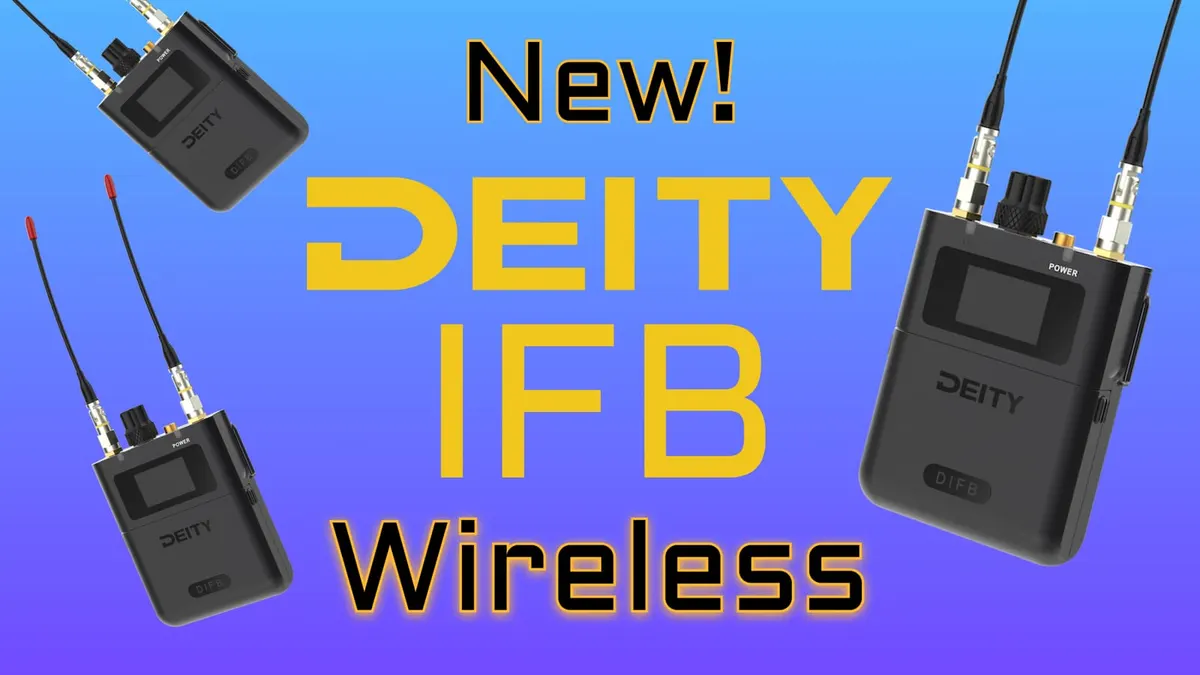
In this week’s episode we have a look at and listen to DEITY’s new IFB system, the HUSH Wireless (for North America) or THEOS DIFB (for other markets). The DIFB system is easily integrated with other DEITY ecosystem products, and also holds its own as an isolated IFB ecosystem for North American users. In this episode we explore what an IFB is, what they’re most useful for, and how it might be used to create a camera hop audio feed. Let’s take a closer look and listen!
Listen to an uncompressed and unprocessed audio sample of the DIFB used for a camera hop between a Sound Devices MixPre-3 II and a Canon C70.
Gear used or mentioned
The links below are Amazon, B&H Photo, Sweetwater, or other affiliate links. As an affiliate, I earn from qualifying purchases.
- DEITY HUSH Wireless DIFB Kit
- Sound Devices MixPre-3 II — 32-bit float audio recorder
- Sennheiser MKH50 — microphone
Read the transcript
What is an IFB? An IFB system — interruptible foldback — is a wireless system that’s used on set for video production, TV, and film. IFB was originally used largely in news as a form of one-way wireless audio used on set or in studio, where news anchors would wear a receiver getting a feed of audio from their director or producer. On the sets I’ve worked on, it’s usually used to send audio from the audio recorder or mixer to a director or producer, or from the recorder to camera so the camera also records quality production audio along with picture. Overall, an IFB is an efficient hands-free way to remotely make sure everyone gets a feed of the production audio, keeping the production coordinated and running smoothly.
Let’s talk specifically about the Deity Hush DIFP. Professional IFB systems from companies like Zaxcom and Lectrosonics can be quite expensive since you buy all the pieces separately. The DIFP is much more affordable — a kit with a transmitter and three receivers runs $950 US.
There’s an international version and a US version. The international version can pair with any Deity Theos transmitter, so you can integrate the DIFP kit with an existing Deity Theos wireless microphone system. The North American version has some differences due to patents held by other companies in the United States — you cannot use a Deity Theos wireless transmitter with it, and it doesn’t support Bluetooth headphone pairing. One positive difference for the US version: the amount of spectrum each IFB transmitter uses is smaller, so you can fit five different transmitters within a 2 MHz range, letting you move your IFB wireless into frequency ranges you’re not typically using for your microphones.
It also has 11 ms latency, which Deity compares to standing 12 feet away from someone talking to you — good performance for the price point. The overall DIFP feature set includes a tunable ultra-wide frequency range from 550 MHz up to 960 MHz, a 20-slot frequency library so you can store and switch between up to 20 different frequencies, and phone pairing and control just like the Theos system, including GPS-based help complying with local wireless regulations. Battery life is up to 15 hours with Deity lithium batteries, less with other battery chemistries — typically 8 to 9 hours with nickel-metal hydride.
Here’s a sample of using the DIFP to send audio from my Sound Devices MixPre over to my camera, the Canon C70: the JZ Microphones V11 goes via XLR into the MixPre, which sends audio at line level to the DIFP transmitter, which sends it to the DIFP receiver sitting on the Canon C70. In post, all we do is boost the levels to -23 LUFS with no other processing so you can hear what it sounds like unprocessed.
If you have questions about how to set this up, let me know down below — we may cover this on the sound-for-video sessions on my other channel, Curtis Judd Audio. In the meantime, get out there and make some great sound. Talk to you again soon.