
What is RF spray from wireless microphones? ft. the DEITY Theos and Saramonic K9
· Audio · Wireless systems · 4:33
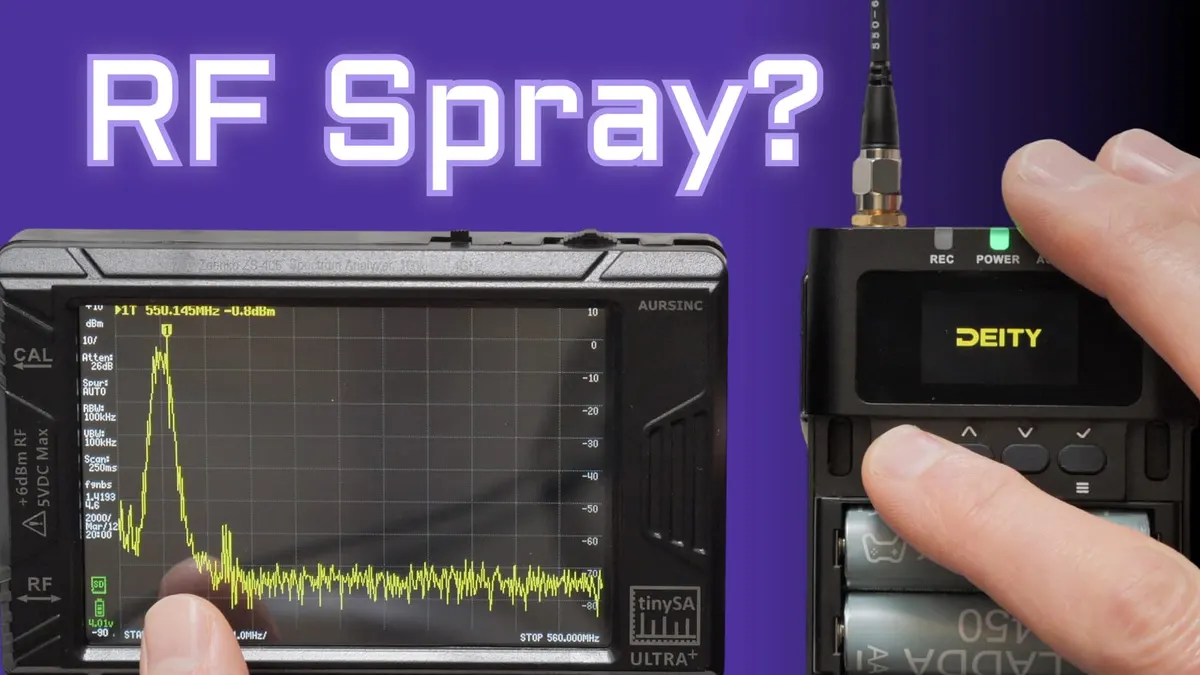
What is RF spray in the world of UHF wireless microphones? We show you how some consumer (or prosumer) wireless microphones behave badly and send out a signal at frequencies that they’re not tuned to…
Gear used or mentioned
The links below are Amazon, B&H Photo, Sweetwater, or other affiliate links. As an affiliate, I earn from qualifying purchases.
- DEITY THEOS — digital wireless microphone system
- Saramonic K9 — digital wireless microphone system
- AURSINC TinySA Ultra+ — RF spectrum analyzer
Read the transcript
A look at “RF spray” — a criticism leveled at both the Deity Theos and Saramonic K9 wireless microphone systems. Using a real-time RF spectrum analyzer scanning 549-560 MHz: powering on a Deity Theos transmitter tuned to 558MHz briefly transmits at 550MHz before settling on its actual tuned frequency; the Saramonic K9, tuned to 555MHz, shows the same behavior, briefly hitting 550MHz before moving to 555MHz, along with what appears to be some intermodulation. By contrast, powering on a professional Sound Devices A10 transmitter goes straight to its tuned frequency (554.2MHz) and occupies a noticeably narrower slice of spectrum, with no spray at all.
Why this matters: if any other wireless mic on set happens to be tuned to 550MHz, powering on one of these consumer/prosumer transmitters will interfere with it, causing dropouts or bad audio — a serious problem if you’re recording or live at the time. It’s an even bigger issue on complex productions (film/TV sets, large events, sports venues with multiple broadcasters) where a dedicated frequency coordinator manages which transmitter uses which frequency across many channels, since there isn’t enough spectrum bandwidth to tolerate this kind of interference. Some venues and productions (likely including Broadway) simply won’t allow systems that spray like this.
For freelance video work — solo shooters or small production companies doing simple interviews with one or two people — this generally isn’t a practical problem, and that’s where these systems are best suited. But if you aspire to work on bigger productions running many channels of wireless simultaneously, make sure any system you buy or rent doesn’t spray RF at 550MHz on power-up. A future episode will cover how higher-end systems manage to run more simultaneous channels of audio. Get out there and make some great sound, and we’ll talk to you again soon.